
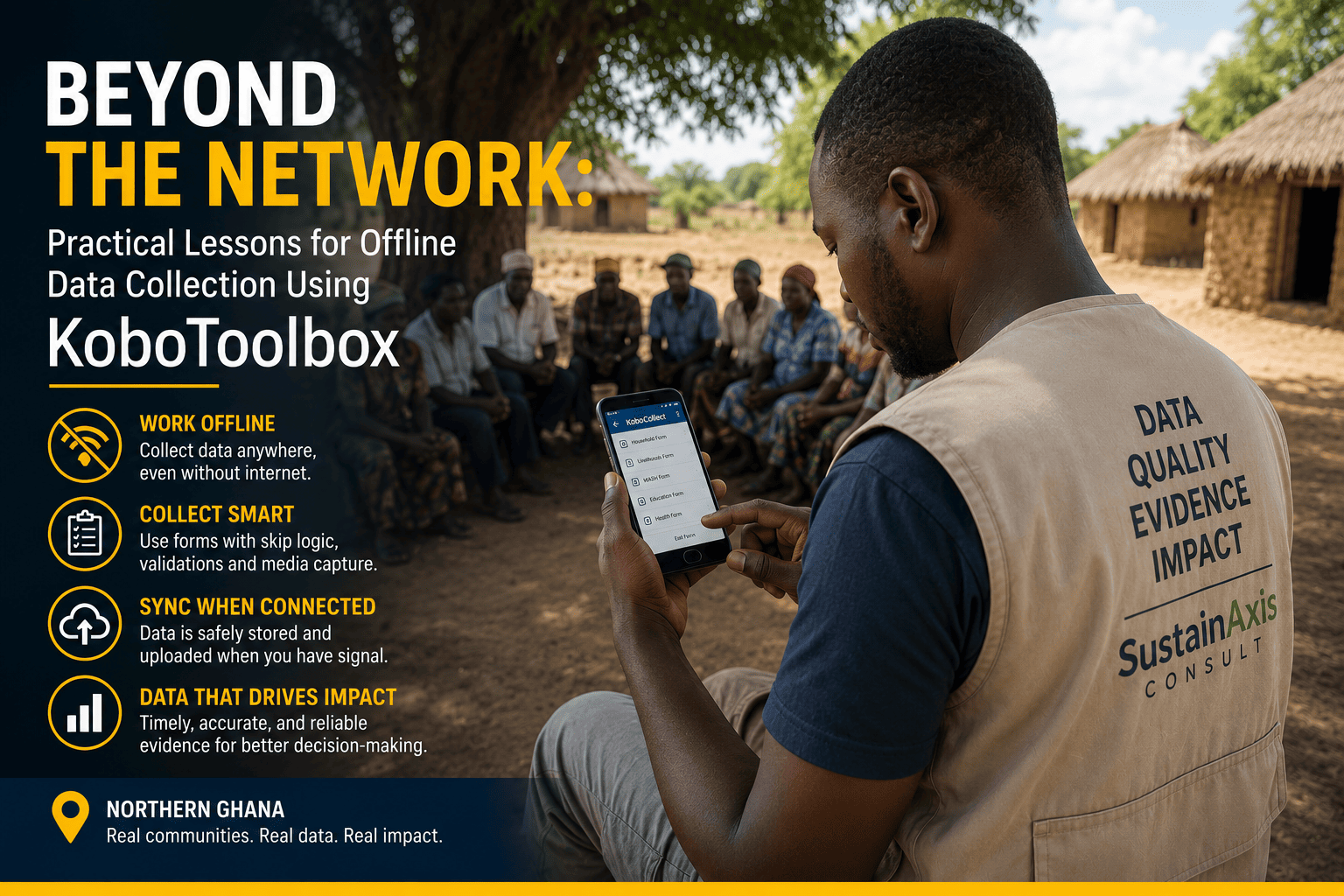
There is a familiar point on many roads in northern Ghana where the mobile signal simply disappears. It usually happens about thirty or forty minutes after leaving the district capital, often just beyond the last fuel station. From that point onward, there are no phone calls, no internet browsing, and certainly no cloud services.
Yet this is exactly where some of the most important Monitoring and Evaluation (M&E) work takes place.
Whether conducting a baseline survey, monitoring project implementation, carrying out a needs assessment, or collecting endline data, the work must continue regardless of network coverage. Hundreds of households may still need to be interviewed, GPS coordinates recorded, photographs captured, and evidence documented.
The challenge facing every M&E practitioner is simple.
How do you collect data you can trust in places where the internet has not reached?
For many years, the answer was paper questionnaires. While paper served the development sector well, it also introduced numerous opportunities for error. Questionnaires became damaged by rain, misplaced during transport, or returned with incomplete responses. Handwritten notes had to be interpreted weeks later by someone who had not conducted the interview. Every completed questionnaire then required manual data entry, creating another opportunity for mistakes.
Each additional step between the respondent's answer and the final spreadsheet increased the risk of compromising data quality.
Fortunately, digital data collection has transformed the way fieldwork is conducted.
Why KoboToolbox Works So Well Offline
Among the many digital data collection platforms available today, KoboToolbox has become one of the most trusted tools for humanitarian and development organisations.
Its greatest advantage is not simply that it is free. It was specifically designed for environments where internet access is unreliable or completely unavailable. Instead of treating the lack of network as a problem, KoboToolbox treats it as a normal part of fieldwork.
Completed interviews are securely stored on the mobile device and uploaded only when an internet connection becomes available. This allows enumerators to continue working throughout the day without worrying about connectivity.
For organisations working in remote communities, this capability is invaluable.
A Workflow That Works
Through years of field experience, we have found that a simple and disciplined workflow consistently produces reliable data.
1. Build the Form Carefully
Design the questionnaire in KoboToolbox before deployment. Choose the appropriate question type for every variable, including text, numbers, multiple choice questions, GPS coordinates, dates, photographs, and calculations.
Good data collection begins with a well-designed questionnaire.
2. Test Every Part of the Form
Never assume the form works because it looks correct.
Complete several test interviews and intentionally follow every skip pattern, validation rule, and calculation. The office is the best place to discover errors. The field is often the most expensive place to correct them.
3. Pilot the Questionnaire
A pilot survey allows you to identify questions that respondents may not understand. It also reveals missing response options, confusing wording, and questions that take longer than expected.
Small improvements during piloting can prevent major problems during full-scale data collection.
4. Collect Data Offline
Using the KoboCollect application on Android devices, enumerators can complete interviews exactly as they would if they were connected to the internet.
Each completed interview is securely stored on the device until network coverage becomes available.
No internet connection is required while collecting data.
5. Synchronise When Connectivity Returns
Once the team reaches an area with mobile network coverage, usually later in the day or after returning to the district capital, completed interviews can be uploaded to the KoboToolbox server.
Supervisors can immediately begin reviewing submissions, tracking progress, and identifying quality issues while field teams are still available to revisit respondents if necessary.
Four Mistakes That Still Catch Teams Out
Even experienced field teams make mistakes that affect data quality. Fortunately, most of them are preventable.
1. Untested Skip Logic
Skip logic is one of KoboToolbox's most powerful features. It is also one of the easiest places to make mistakes.
If a condition is incorrectly programmed, respondents may be asked questions they should never see, or entire sections of the questionnaire may be skipped.
The danger is that these errors can continue unnoticed throughout the entire survey.
Always test every possible path before deploying the questionnaire.
2. Using English-Only Questionnaires
Many questionnaires are designed entirely in English, even though respondents speak Dagbani, Gonja, Mampruli, Hausa, Ewe, Twi, or other local languages.
When enumerators translate questions differently during interviews, they unintentionally conduct different versions of the same survey.
Where possible, include local language translations directly within the KoboToolbox form and ensure enumerators are fluent in the language spoken by respondents.
Consistency begins with communication.
3. Capturing Large Photo Files
Photographs are often important for verification, but unnecessarily large image files create avoidable problems during synchronisation.
High-resolution photographs can significantly slow uploads when network coverage is weak.
Resize images before deployment and request photographs only when they genuinely contribute to the indicator being measured.
4. Waiting Until Fieldwork Ends Before Reviewing Data
One of the costliest mistakes is waiting until the entire survey is complete before checking submissions.
Daily reviews allow supervisors to identify unusually short interviews, missing GPS coordinates, inconsistent responses, duplicate records, or misunderstood questions while enumerators are still in the field.
Problems discovered immediately can often be corrected.
Problems discovered weeks later usually cannot.
Good Data Is Built Before It Is Collected
Reliable data does not happen by chance.
It is the result of thoughtful questionnaire design, careful testing, well-trained enumerators, effective supervision, and continuous quality assurance throughout the data collection process.
Offline data collection should not be viewed simply as a technical feature of KoboToolbox. It should be recognised as a disciplined approach to fieldwork that enables organisations to produce accurate, complete, consistent, and timely data, even in the most remote communities.
When these practices become standard, the quality of evidence improves, project decisions become stronger, and reporting becomes more credible.
Learn the Complete Process
These practical lessons form part of Module 4 of our free M&E Fundamentals online course.
The module guides participants through:
- Selecting appropriate data collection methods.
- Designing effective questionnaires.
- Understanding sampling and avoiding roadside bias.
- Building forms in KoboToolbox.
- Configuring KoboCollect for offline data collection.
- Synchronising completed interviews.
- Conducting practical data quality checks.
The course is free, self-paced, and concludes with a verifiable certificate that participants can proudly add to their professional portfolio.
Final Thoughts
Technology has changed the way development practitioners collect data, but technology alone does not guarantee quality.
Reliable evidence comes from good preparation, disciplined field procedures, and continuous attention to detail.
The mobile signal may disappear along the road, but your commitment to data quality should never disappear with it.
If you have learned valuable lessons while collecting data in remote communities, we would love to hear your experience. Share your insights with us via our comment section or via info@sustainaxisconsult.org. Together, we can continue improving the quality of data that drives evidence-based development.