
There is hardly a programme proposal written today that does not carry a Theory of Change. Donors expect one, evaluators ask for it, and the proposal template leaves a neat space for it. The Theory of Change, or ToC, was meant to be the place where a programme team thinks hard about how and why change will happen, and lays bare the assumptions beneath that belief. Done well, it is one of the most useful instruments we have in development practice. Done as most of us have actually seen it done, it becomes a tidy diagram that decorates a proposal and is never looked at again.
Across the programmes I have worked on in Ghana and the wider region, the Theory of Change tends to fail in three recognisable ways. None of them is about the diagram being drawn incorrectly. Each is about how the ToC is treated once the ink has dried. The encouraging part is that every one of these failures has a practical remedy, and the remedies are within reach of even a small organisation working on a modest budget.
Pattern 01The Theory of Change is built to be filed, not used
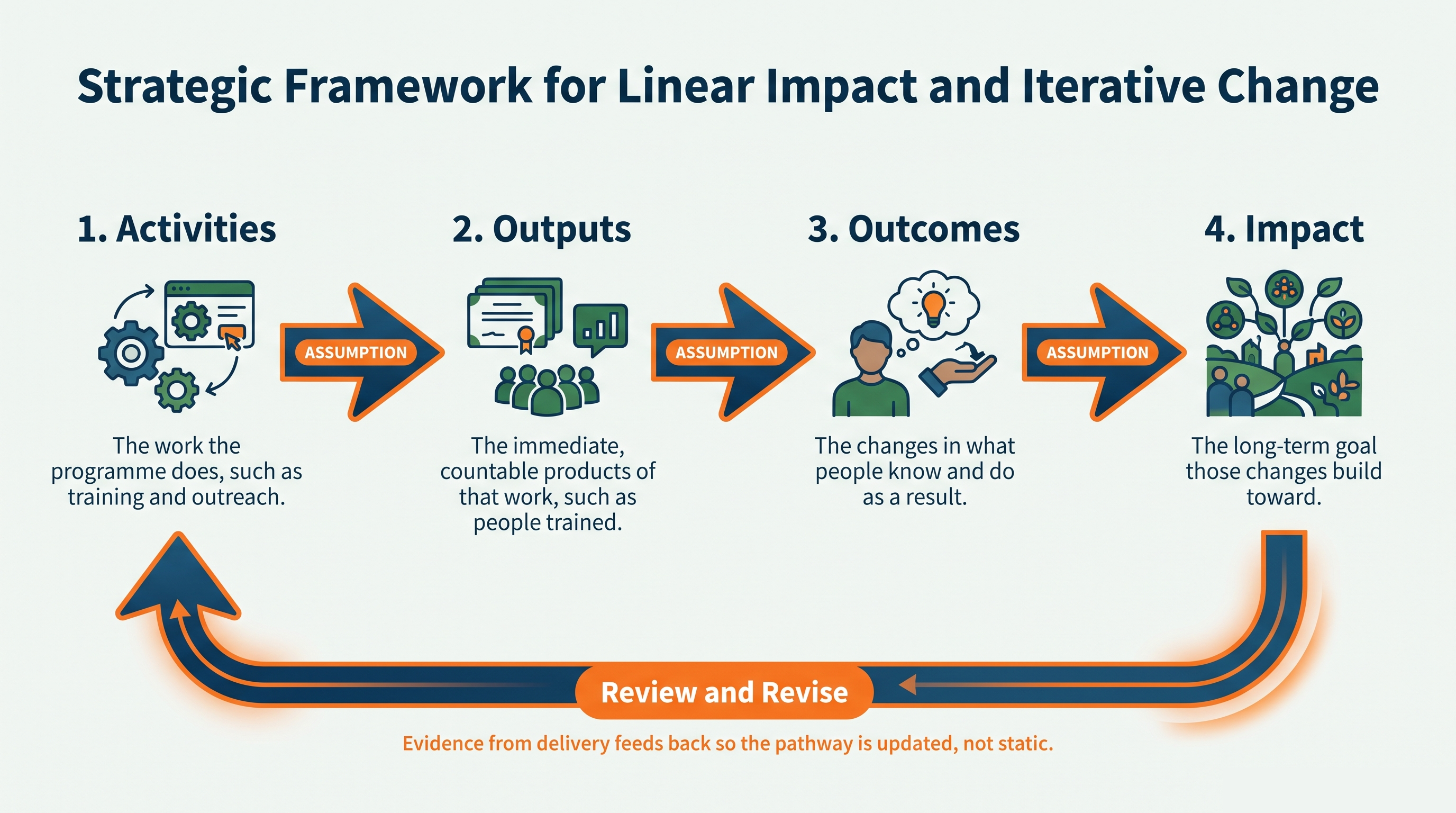
The most common fate of a Theory of Change is the filing cabinet. A consultant builds it during proposal design, often in a hurry, the donor approves it, and it is bound into the proposal annex. Implementation then proceeds on the strength of workplans and budget lines, and the ToC is not opened again until an evaluator, near the very end, asks the team to assess performance against it. By then it is a historical document, not a guide.
This fails because the value of a Theory of Change was never in the artifact. The value is in the thinking it forces, and in the decisions it shapes while the programme is still running. A ToC that sits in an annex cannot shape a single decision. I once reviewed a livelihoods programme in the north whose ToC rested quietly on farmers reaching a reliable market for their surplus. Midway through the programme the nearest market had shifted and transport costs had climbed, but because no one returned to the ToC, the assumption that held the whole pathway together went unquestioned until the final evaluation made it painfully clear.
What to do about it
Treat the Theory of Change as a living document rather than a deliverable. Bring it into the room at every review meeting, literally on the wall, and put one question to it each time fresh monitoring data arrives. Does the evidence we now hold still support the pathway we drew? Where it does not, redraw it. A Theory of Change that has not been edited since the proposal was written is almost certainly out of date. Over a three-year programme you should expect to revise it several times, and each revision is a sign the tool is working, not a sign that it failed.
Pattern 02Assumptions are listed but never tested
Look closely at most Theories of Change and you will notice that the boxes are confident while the arrows between them are silent. Yet it is in those arrows, in the leap from one box to the next, that the real risk of a programme lives. Assumptions are where we quietly admit that the leap depends on conditions we do not fully control. Too often, though, they are treated as a formality. They are written in slogans, political stability will hold, communities will participate, and then they are never looked at again.
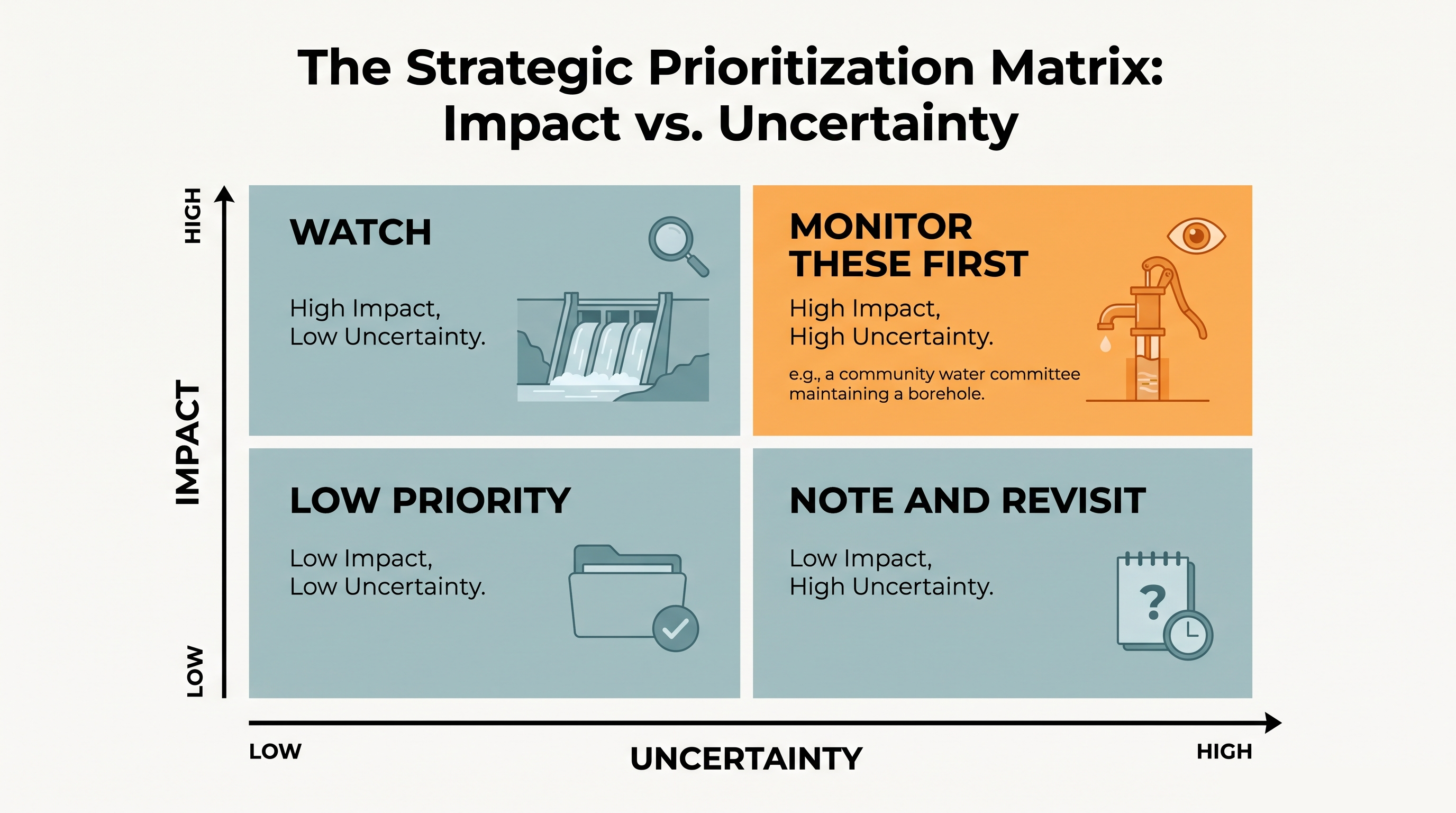
This fails because the assumption is precisely where programmes break. If the riskiest assumption in your pathway goes unmonitored, you are flying blind on the very thing most likely to bring the programme down. Consider a water and sanitation programme that rests, as so many do, on a community water committee maintaining the borehole long after the project staff have gone. That single assumption, that volunteers will keep up the maintenance season after season, often carries the entire sustainability of the investment. Yet it is rarely watched. The committee quietly stops meeting, and nobody knows until the pump fails and the community is back where it started.
What to do about it
Treat your assumptions as the research questions of the programme. Name them specifically, not in slogans. Then map the few that matter most, the ones that are both highly uncertain and highly consequential, and give those your real attention. Turn each into something you can actually test, attach a simple indicator to it, and watch it as the data comes in. If the survival of a water committee is the assumption your sustainability depends on, then the functioning of that committee belongs in your monitoring plan, not in a footnote.
Pattern 03The Theory of Change is designed in the workshop, not the field
The third failure begins at a hotel conference table. A Theory of Change is built by a team of consultants and senior managers over two intense days, sometimes without the field officers who will carry the programme, and almost always without anyone from the community it is meant to serve. What emerges can look elegant on paper and still be wrong, because the people who hold the local knowledge that would have grounded it were never in the room.
This fails for two reasons that feed each other. First, a Theory of Change is a shared hypothesis about how change happens in one particular place, and if the local knowledge is absent, the hypothesis is missing the very thing that would make it true. Second, the people expected to act on the ToC have no stake in something they did not help to shape. I have watched a peacebuilding Theory of Change built on the belief that regular dialogue forums would ease community tensions. Local elders, had they been at the table, would have said early what the programme learned late, that the tension was rooted in a land and chieftaincy dispute the forums never once touched.
Complexity is not the same as rigour. A Theory of Change that only its authors can read is too complicated to guide anyone.
What to do about it
Build the Theory of Change with the people who will use it and live with it. Put field officers and community representatives in the room from the start, and let their knowledge shape the pathway. Keep the diagram simple enough that a field officer can explain it to a colleague without notes. A ToC that a community member recognises as a fair description of their own reality is worth far more than a dense web of boxes that only impresses a donor.
Designing for learning, not for compliance
The thread running through all three failures is the same. Each treats the Theory of Change as a fixed artifact to be produced once and defended, rather than a living hypothesis to be tested and revised as the programme teaches you what is actually true. Shift that one belief and the tool comes back to life.
A Theory of Change designed for learning is built to travel through the whole programme cycle. It is shaped at design with the people who know the context. It is monitored through implementation, with its riskiest assumptions watched as closely as its indicators. It is revisited at every review, and redrawn whenever the evidence demands it. Used this way, the ToC stops being the thing that slows a programme down at reporting time, and becomes the thing a team returns to when the data surprises them and they have to decide what to do next.
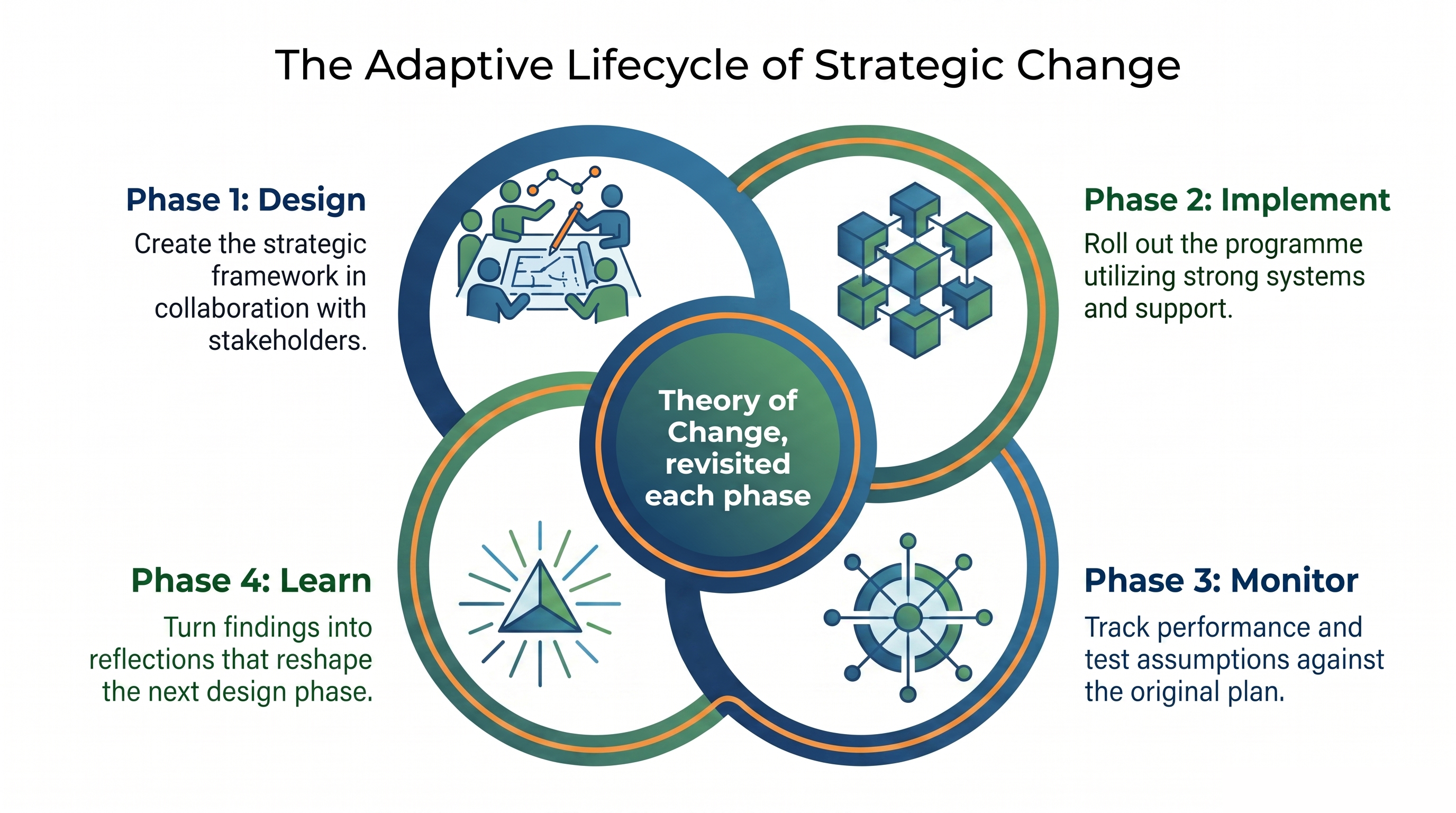
At SustainAxis we hold that evidence is the blueprint. A Theory of Change, done honestly, is simply the blueprint you keep redrawing as the evidence comes in. The programmes that learn are the ones willing to redraw it.